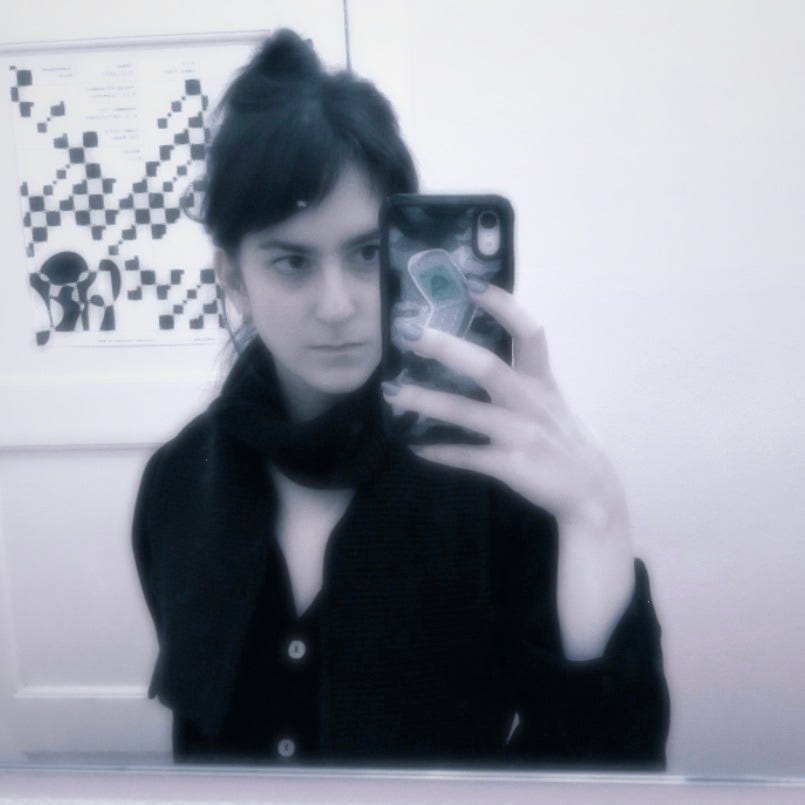
Adina Glickstein is this generation’s Nan Goldin, but for alternative technology communities.
What is the Open Social Network Cookbook?
Last winter, the Media Economies Design Lab at the University of Colorado ran the Open Social Incubator, a peer learning initiative that brought together activists, artists, and community-builders from all over the world to explore various kinds of alternative social media platforms and protocols. We were interested in the question of what makes for more democratic and accountable online communities and in the labor, care, and many delicate balancing acts required to sustain such a space.
After 6 months of group discussions, workshops, and reflection, each participant wrote a “recipe” breaking down some of their learnings. The Open Social Network Cookbook is a snapshot of participants’ thought processes – from Mac Andre Arboleda’s dictum on the value of seduction (he cites ‘hacker hotties’ as an essential ingredient) to Kadallah Burrowes’ oral telling of an origin myth collectively fabulated by their pan-African artist collective, ANANSI.
Why did you make it?
We wanted to create a publication of some kind that could disseminate some of the learnings from the incubator, without being too prescriptive or didactic. It was important that the publication wasn’t just piling onto the information overload or succumbing to the “infographic-as-knowledge” logic of our platformed present. In step with the peer learning format of the incubator itself, we were interested in finding a publication format that enabled people to pose questions for future elaboration or invite other tinkerers to build on their work. (Many jokes were made about the possibility of “forking.”)
So a cookbook felt like the right format: recipes are like protocols but they’re also more loose and suggestive. They carry an implicit encouragement to the user to tweak, defer to embodied knowledge and experience, measure from the heart. Cooking is also an area where skills and knowledge are passed down among kin and across generations, which we hope some of the technical skills in the cookbook might also be. Hence, a cookbook was a low-pressure way of collecting some actionable insights while also leaving things open for future experimentation and evolution over time.
Who or what inspired you?
The participants in the incubator were the biggest inspiration. Every single one of them had so much to teach, and with so much spice and style. Nathan Schneider, who directs MEDLab, has this great line in his book Governable Spaces about shifting the ethos of online spaces from “homesteads” (colonialist mindset grounded in the cyber-libertarian imaginary of the digital frontier) to “homeplaces” (spaces of true relational belonging, cf. bell hooks). The desire to equip people to create virtual spaces that feel more like homeplaces was one of the major inspirations for this incubator.
When we first introduced the idea for a publication at one of the group meetings, some of the reference points that Antoinette Kendrick (my co-facilitator and an incredible PhD student working with MEDLab) and I surfaced for “alternative cookbooks” included The Anarchist Cookbook (lol) and The New Women’s Survival Catalog. I tried really hard not to talk about Stewart Brand but we still ended up talking about Stewart Brand. I guess the idea of scalable tools for transformation lingered inside the imaginary of this project.
Much of our work was also underpinned by Black feminist thought – from the aforementioned idea of the “homeplace” to Audre Lorde’s “Uses of the Erotic” essay guiding discussions about how to make digital spaces that are pleasurable to inhabit. We talked a lot about the idea of “kitchen table politics” as a frame for grassroots organizing, coming out of Black feminism, which also obviously jives with the “cookbook” metaphor.
Download the Open Social Network Cookbook, and remember to read User Error, Adina’s best-of-class internet-column at Spike.